
 EN
 ru
 pt
How to Find Trustworthy PVC Glue Manufacturers: A Complete Verification Checklist Before Bulk Orders
Nov 09, 2026Introduction
PVC solvent cement serves as an essential consumable for municipal pipe networks, building water supply and drainage systems, industrial piping, as well as UPVC and CPVC pressure and drainage projects. Low-quality PVC glue easily triggers joint leakage and full pipeline failure, resulting in costly rework. For export orders, it may also bring compliance risks during customs clearance. Many overseas buyers and building material distributors only focus on unit pricing while overlooking factory qualifications, formulation compatibility and long-term supply stability.
Whether you work as a building material distributor, engineering contractor or a brand owner seeking custom private-label products, multi-dimensional verification before placing bulk orders can greatly reduce risks related to quality, compliance and delivery. This practical checklist covers factory capability assessment, product performance testing, packaging and logistics, OEM support and commercial terms to help you evaluate PVC glue suppliers.
1. Verify Manufacturer Qualifications and Production Capacity
Sourcing directly from a genuine adhesive manufacturer rather than an intermediary trader lays the foundation for stable procurement. Many suppliers on the market simply repackage and resell products without independent formulation and mass-production capabilities.
· Check factory background: Confirm production qualifications, plant scale, quality control workflows and in-house laboratory resources. Prioritize manufacturers equipped with complete solvent adhesive production lines instead of simple blending workshops.
· Clarify production lead times: Confirm the turnaround for large orders. A typical lead time for industrial-grade 1000 ml PVC glue ranges from 7 to 15 working days. Also check whether the manufacturer supports container consolidation, small trial orders and flexible minimum order quantities.
· Assess export expertise: For cross-border purchases, review the manufacturer’s export track record, familiarity with hazardous goods sea freight regulations and availability of leak-proof packaging designed for overseas shipments.
Red flag alert: If a supplier cannot provide factory photos, production line documentation or delivers inconsistent lead time estimates, it is most likely a reseller. Such traders carry higher risks of inconsistent formulations and unreliable after-sales support.
2. Confirm Formulation Compatibility with Piping Materials
A common procurement misconception is that one type of PVC glue works for all pipes. PVC, UPVC and CPVC feature distinct polymer compositions. Mismatched solvent cement fails to create molecular fusion, which may generate microcracks and hidden leakage hazards.
Key points for cross-verification
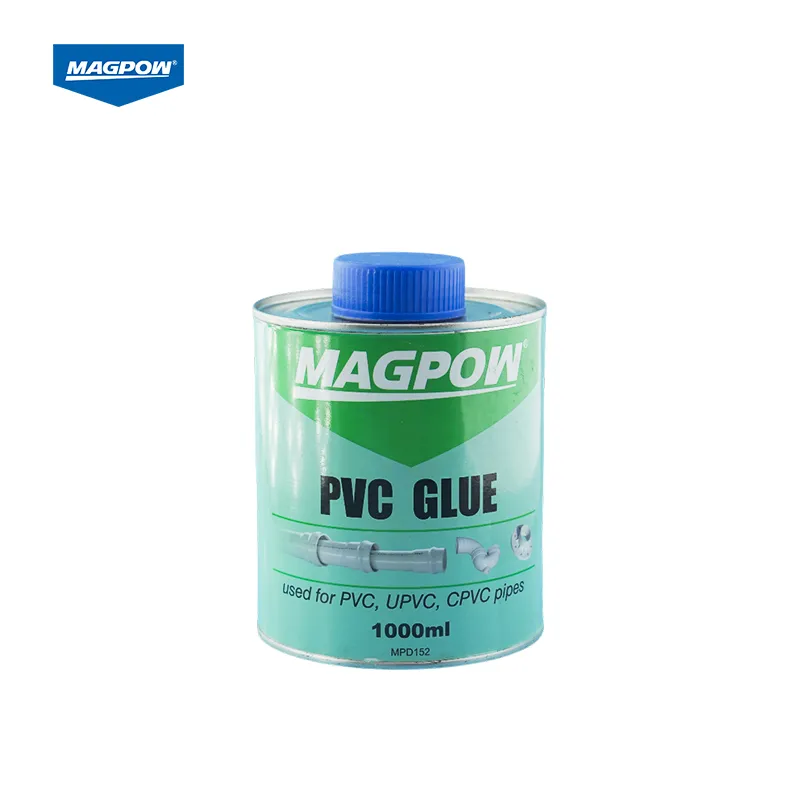
· Applicable pipe types: Distinguish glues formulated for rigid PVC drain pipes, sewage UPVC pipes and heat-resistant CPVC hot-water piping. MAGPOW’s 1000 ml industrial PVC glue bonds PVC, UPVC and CPVC, delivering reliable molecular solvent welding for both cold and hot water pipelines.
· Application scenarios: Differentiate lightweight residential formulas and heavy-duty industrial blends built for large-diameter municipal pipelines. Heavy-duty variants deliver superior fusion strength to withstand high water pressure and mechanical stress within civil engineering networks.
· Customizable options: Ask whether the manufacturer can adjust glue colour (clear, grey, translucent blue, etc.), viscosity and setting speed to suit local climates, such as hot tropical regions or low-temperature zones.
Always run sample tests before bulk placement
Before issuing a formal purchase order:
1. Request product samples from the manufacturer.
2. Carry out bonding trials using locally sourced pipes and fittings.
3. Inspect the glue itself: qualified solvent cement maintains a homogeneous viscous texture with no separation, sediment or abnormal discolouration.
4. Complete hydrostatic leak testing once the adhesive fully cures. Never rely solely on marketing descriptions to judge performance.
3. Review Packaging, Applicators and Shelf-Life Standards
Packaging directly affects construction efficiency, long-term storage stability and leak resistance during long ocean voyages, a detail frequently neglected by buyers chasing lower prices.
· Container specifications: Confirm bottle sizes such as the widely used 1000 ml format and check for integrated applicator brushes attached to the lid. Built-in brushes enable even coverage, reduce adhesive waste on site and speed up installation.
· Container labelling: Original packaging should clearly display the brand name, product model, volume, compatible substrates, hazard warnings, production date and shelf life.
· Export-grade outer cartons: Reinforced multi-layer cartons are required for sea transport to prevent leakage amid rough handling and long transit periods. Confirm whether the supplier offers packaging that meets export standards.
· Shelf life and storage guidance: Solvent cement has a limited shelf life. Improper storage causes solvent evaporation and alters viscosity. Ensure traceability of production batches for every incoming shipment.
4. Verify OEM and Private-Label Capabilities (For Brand Importers and Distributors)
If you plan to launch your own branded product line, confirm the following customisation terms before entering cooperation:
1. Custom labelling support: Check if the factory offers bottle screen printing, custom adhesive stickers and personalised outer carton marking.
2. Formulation flexibility: Confirm whether viscosity, open time and colour can be adjusted to match local building codes and regional climate conditions.
3. Intellectual property protection: Make sure the manufacturer will not reuse your exclusive label designs for other clients.
4. Minimum order quantities for OEM services and turnaround times for label proofing and pre-production samples.
5. Clarify Commercial Terms and Contract Risk Clauses
Even validated samples cannot prevent disputes if contract language remains ambiguous after mass delivery. Include these critical clauses in your agreement:
1. Minimum order quantities, tiered pricing, payment schedules and confirmed delivery timelines.
2. Batch consistency requirement: Mass-produced goods must retain the identical formulation and performance of the pre-approved samples.
3. Quality inspection window: Agree on the inspection period after cargo arrival and define remediation protocols for non-conforming products.
4. Liability for cross-border transit damage: Clearly assign responsibility for leakage and breakage during ocean shipping.
5. Supporting deliverables: Outline obligations for supplementary materials such as custom labels and colour boxes to be dispatched alongside each shipment.
Conclusion
Purchasing PVC glue involves far more than comparing unit prices. Trusted PVC glue manufacturers deliver stable formulations, scenario-focused product designs, rigorous quality control and mature export support. For municipal projects, industrial piping networks and bulk building material distribution, contractor-sized 1000 ml PVC solvent cement reduces frequent bottle replacements on site and boosts overall construction productivity.
Before locking in a supplier, work through this verification checklist, conduct practical sample testing and confirm all supporting arrangements. If you are sourcing industrial-grade pipe bonding solutions, you may review MAGPOW 1000ml PVC Glue for factory-direct solvent cement specifications and available services.
FAQ
Q1: What is the core difference between industrial-grade PVC glue and regular residential versions?
A: Heavy-duty industrial formulas achieve stronger molecular bonding and maintain reliable performance under sustained high pressure, making them suitable for large municipal pipelines. Residential blends generally have lower viscosity and are only intended for low-pressure drainage systems. Mixing them is not recommended.
Q2: Why is hydrostatic testing with samples mandatory?
A: Pipes produced in different regions vary in raw materials and manufacturing techniques. Even glue with excellent technical parameters may fail to bond well with local fittings. Pressure testing is the most straightforward method to identify potential leakage risks in advance.
Q3: What special requirements apply to PVC glue ordered for hot climate regions?
A: High temperatures accelerate solvent evaporation. Ask the manufacturer to supply a variant with a longer open time. You should also arrange shaded and temperature-controlled storage during warehousing and sea freight to avoid premature thickening and performance loss.
Q4: How long does OEM sample development usually take?
A: Once label and carton proofs receive final approval, sample preparation normally takes 7 to 12 working days. The exact timeline depends on requirements such as screen printing, custom bottle designs and formulation fine-tuning.