
 EN
 ru
 pt
Quick Setting Epoxy Glue for Wood: Why Fast Cures Fail — and How to Choose One That Doesn't
Oct 27, 2026Quick Answer
Most "quick setting epoxy glue for wood" complaints trace to three specific failures: the glue never fully cures and stays tacky, it cures rubbery instead of rigid, or the bond lets go after moisture exposure because the wood around it swells and loads the bondline.
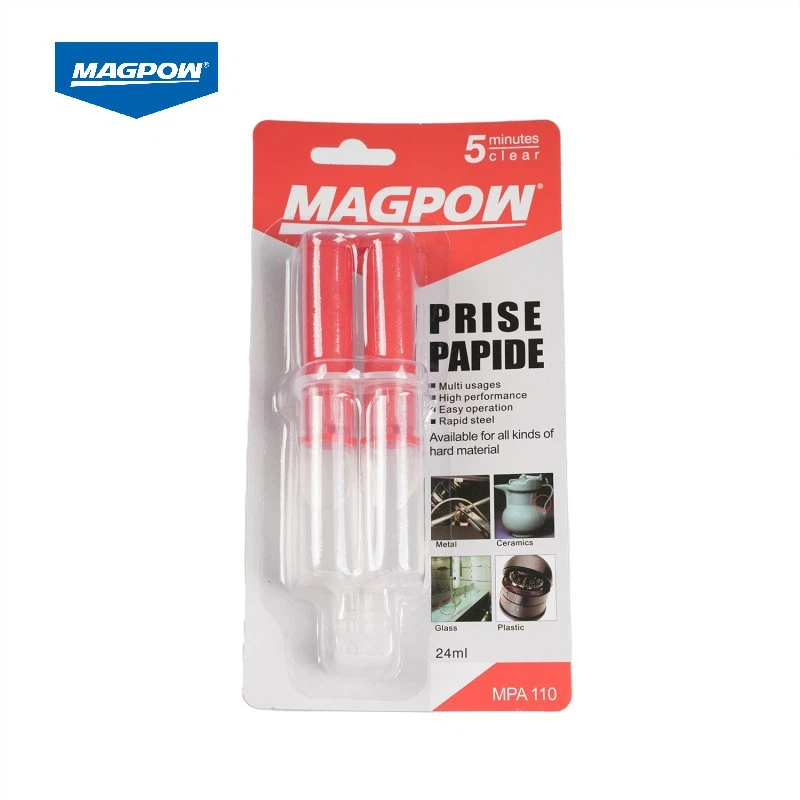
A functional quick-set wood epoxy needs a short but realistic handling window at room temperature, a rigid cured film, and enough gap-filling body to cope with joint faces that no longer mate cleanly. Magpow's Quick Setting Epoxy Glue for Wood (MPA110) is built to that brief: handling strength in 4–6 minutes at room temperature, an initial set at around 5 minutes, a full cure of 2–24 hours depending on temperature, and a cured film the product page describes as an exceptionally hard, rock-like finish that can be sanded, drilled, machined, and painted.
A five-minute epoxy is not a structural adhesive. It is a repair adhesive for small, clampable joints — and the sooner a buyer accepts that boundary, the fewer disappointing purchases they make.
The Three Failure Modes Buyers Actually Experience
Failure Mode 1: "It Never Hardens"
The most common one-star review on quick-set wood epoxies reads like this: "This product claims it dries in a few minutes. I mixed as directed and applied over five months ago. It's still sticky."
In most cases this is not a technique problem. It is a dispensing problem. Two-part epoxies cure by a stoichiometric reaction between resin and hardener: if the ratio that reaches the joint is off, unreacted resin is left behind and the film stays tacky indefinitely.
Dual-barrel syringe packaging is the practical defence. The two components are metered side by side, so the ratio is set by the package rather than by the user's eye — but only if both barrels actually flow and the plunger is depressed fully and evenly. A partially blocked barrel, a cap left on one side, or a half-pressed plunger all reproduce the same failure, and the label gets the blame.
What to check before buying: does the package mechanically meter the two components, or are you judging the ratio by eye? Magpow supplies MPA110 in double syringes (25 ml and 50 ml), tube kits, and bulk industrial tins; for small repairs the syringe format is the one that takes ratio guesswork out of the job.
Failure Mode 2: "It Dried Like Rubber, Not Glue"
A second recurring complaint: "It dried like a rubber substance, I had to peel it off and use something else."
This is usually not a defective batch. It is the wrong cured state for the joint. Some fast-cure systems are deliberately flexibilised or toughened, which is useful where an assembly vibrates or where two substrates expand at different rates. On a rigid wood joint, a soft adhesive layer becomes the weak link: the bond does not fail at the wood surface, it fails cohesively inside the adhesive itself, and it peels away in one piece when you test it.
For wood repair you want a rigid cured film that transfers load between the two faces instead of absorbing it. Magpow's product page describes MPA110 as curing to an "exceptionally hard, rock-like finish", and lists sanding, drilling, machining, and painting as post-cure operations — all of which assume a hard, dimensionally stable film rather than a rubbery one.
Read the cured-state description, not the "toughness" headline. Flexible and tough are not synonyms for strong in a rigid joint.
Failure Mode 3: "It Held Fine — Until It Got Wet"
This is the failure mode most buyers discover months later, usually on outdoor furniture, a bathroom door, or a repair near a window.
Epoxy has a reputation for water resistance, and a fully cured epoxy film does not re-dissolve in water. The problem on wood is not the adhesive dissolving; it is the wood moving. Wood takes on and gives off moisture, and it swells and shrinks as it does. That movement puts peel and shear load on the bondline, and a fast-cure adhesive that has already reached full hardness has no way to relax it.
This does not make quick-set epoxy unusable near water. It means three things:
• Glue dry, acclimated stock, and check it with a moisture meter before you start. Damp or green timber is a job for a moisture-curing polyurethane, not a fast epoxy.
• Design the joint so water does not sit in it — finish or seal end grain, avoid open gaps that trap water, and do not treat the adhesive as the only barrier.
• Keep the repair out of continuous immersion. A five-minute repair epoxy is not a marine laminating resin, and no product in this class should be sold as one.
If a quick-set epoxy is marketed as waterproof without saying anything about wood moisture, treat that as marketing rather than engineering.
What "Quick" Actually Means: Reading Cure Data Correctly
Buyers routinely confuse three different numbers — initial set, handling strength, and full cure — and a product page that advertises only one of them is hiding the other two.
|
Stage |
What it means in the workshop |
Magpow MPA110 specification |
|
Initial set |
The adhesive has gelled and the parts stay where you put them |
5 minutes |
|
Handling strength |
The joint can be unclamped, moved, and lightly worked without coming apart |
4–6 minutes at room temperature |
|
Full cure |
The film reaches its final hardness and the bond reaches working strength |
2–24 hours, temperature dependent |
Two things follow from that table.
First, the working window is short by design. Four to six minutes is right for repairs where clamps cannot stay on for hours — chair rungs, small furniture joints, jigs, and fixtures. It is wrong for large glue-ups, complex assemblies, or any joint that needs repositioning after clamping. If your repair needs more open time than that, a quick-set epoxy is the wrong tool, and no amount of technique will fix the mismatch.
Second, notice the gap between handling strength and full cure. A joint that is handleable in six minutes is not at working strength for hours, and the 2–24 hour range is temperature dependent: a cold workshop pushes it toward the long end, a warm one toward the short end. Clamp it, leave it, and do not put load on it the same afternoon.
Where Quick-Set Epoxy Beats PVA and Polyurethane — and Where It Loses
Quick-set epoxy is not a universal replacement for wood glue. It wins in specific situations and loses in others, and knowing the boundary prevents the wrong purchase.
Where it wins
• Gap filling. PVA needs tight-fitting joints and has almost no gap-filling body. Epoxy bridges a gap and still cures hard, which is what makes it the right choice for a repair whose joint faces no longer mate cleanly.
• Mixed materials. Bonding wood to metal, glass, or rigid plastic is where epoxy earns its place. Magpow lists MPA110 for hardwood, softwood, plywood, MDF, and particleboard, and for joining wood to metal, glass, and rigid plastics; the same page lists glass, jewellery, crafts, and other transparent materials as repair applications.
• Rebuilding missing material. The product page describes the cured film as filling gaps without shrinking, cracking, or losing volume over time, so it can replace a splintered edge or a chewed screw hole rather than merely joining two faces.
• Moisture tolerance, with caveats. A cured epoxy film does not re-dissolve in water. Polyurethane also performs well outdoors, but it foams as it cures and can push a lightly clamped joint apart. Epoxy does not foam.
Where it loses
• Wet or green wood. Epoxy does not bond reliably to wet timber, while polyurethane actually uses moisture to cure and is the better choice for damp lumber.
• Long open-time assemblies. PVA and polyurethane typically offer 10–30 minutes of working time; MPA110 gives you 4–6 minutes to handling strength. For a complex glue-up, the slower adhesive is the correct one.
• Cost-sensitive interior joinery. For interior furniture with tight-fitting joints, PVA is cheaper, easier to clean up, and sands better.
• Structural and load-bearing work. A five-minute repair epoxy is neither a laminating resin nor a structural adhesive for beams, and it should not be specified as one.
Pre-Purchase Checklist: Five Questions Before You Buy
Answer these five before you open the pack. They separate a product that fits the job from one that will end up in a one-star review.
1. Does the package meter the two components, or are you judging the ratio by eye? A dual-barrel syringe or a dual-chamber tube sets the ratio for you; two separate tins and a guess do not.
2. Does the maker describe the cured state — hard and sandable, or flexible and rubbery? Match that description to the joint in front of you, not to the word "tough" on the label.
3. What is the handling window at your workshop temperature, and can you close and clamp the joint inside it? If not, buy a slower adhesive instead of fighting the cure.
4. How dry is the wood you are repairing? Check it with a meter. Damp, green, or recently wetted timber is polyurethane territory, not fast epoxy.
5. Can you keep the joint out of standing water, and out of load, until full cure? If neither is possible, a five-minute repair epoxy is the wrong product for that job.
If you can answer all five, you are ready to buy any credible quick-set wood epoxy. If you cannot, the question is not which brand — it is whether this class of adhesive suits the repair at all.
Conclusion
Quick-setting epoxy glue for wood is a narrow-purpose tool, not a universal adhesive. It solves three specific problems — fast clamp release on small repairs, gap filling on joints that no longer mate, and bonding wood to non-wood materials — and it fails predictably when asked to do anything else: bond wet wood, survive a long assembly, or stand in for a structural adhesive.
Magpow's MPA110 is specified for the first three: handling strength in 4–6 minutes at room temperature, an initial set at around 5 minutes, a full cure of 2–24 hours depending on conditions, a hard, rock-like cured film you can sand, drill, machine, and paint, and a gap-filling body that does not shrink or lose volume.