
 EN
 ru
 pt
Solvent Neoprene Glue in Industrial Bonding: What It Does, How to Apply It, and How to Source It
Oct 29, 2026Solvent neoprene glue is one of the most widely used contact adhesives in furniture assembly, footwear, and leather goods production. It works on a different principle than water-based or hot-melt adhesives, and that difference decides how the product must be applied and how the finished joint behaves under load. This guide covers what the product actually is, the specification points that determine whether it suits a given job, and the practical steps for applying and sourcing it.
What solvent neoprene glue is
Solvent neoprene glue is a solvent-based contact adhesive built on a chloroprene rubber and synthetic resin solvent blend. In its working state it is a light yellow to amber viscous liquid. As a contact adhesive, it is applied to both surfaces to be joined, allowed to lose solvent (open time), and the two coated faces are then pressed together. Bond strength forms from the contact between the two tacky films rather than from the glue filling a gap, which is why it delivers high initial hold quickly after the solvent flashes off.
Because the base is chloroprene rubber, the cured film stays flexible and keeps its grip under mechanical stress rather than turning brittle. This combination — immediate grab plus a resilient, elastic film — is the reason it is specified for parts that move, vibrate, or carry peel loads.
Where it is commonly used
The product is formulated for multi-substrate bonding and is regularly specified for joining chloroprene rubber, natural leathers, polyurethane foams, decorative laminates, plywood, cork, canvas, metals, and rigid plastics. In practice this maps onto a familiar set of applications:
· Furniture assembly, especially laminating decorative surfaces onto boards and edge banding
· Footwear and shoe making, where sole-to-upper and insole bonds see repeated flex
· Leather goods and upholstery work
· General manufacturing where a fast, flexible, load-bearing bond is required between rigid and flexible materials
The properties that matter on the shop floor
Three performance characteristics determine whether solvent neoprene glue is the right choice for a production line:
Initial tack. The aggressive, immediate grab once the solvent has flashed off allows parts to be positioned quickly without heavy mechanical clamping. This directly affects cycle time in assembly work.
Shear and peel strength. The cured elastomeric film resists high peel loads, thermal expansion stress, and continuous vibration fatigue. This is the property to watch for bonds that will be loaded or flexed in service.
Environmental and aging resistance. The bond holds up under humidity, ambient thermal fluctuation, water immersion, and mild chemical exposure over extended service lives. If a joint will be exposed to moisture or temperature swings, this resistance matters more than raw initial strength.
Reading the specification before you choose
Three specification points matter most when comparing products:
Solid content (18%–30%). Solid content is the proportion of adhesive substance in the can after solvent. A higher-solids product deposits more glue per coat, which generally means a stronger film and fewer coats. Many manufacturers offer this within a customizable range rather than a fixed figure.
Open time (10–25 minutes). Open time is the window in which the coated surfaces must be mated for a strong bond, and it depends on ambient temperature and film thickness. Hotter or drier conditions shorten the usable window; thicker films extend it. Production planning should match open time to how fast operators can position and press parts.
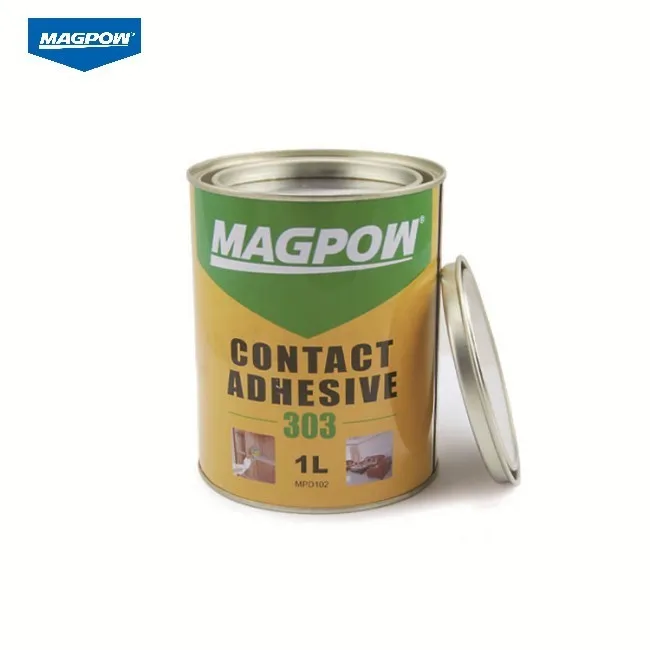
Packaging. Common industrial formats are 1L, 3L, and 18L metal tins or pails, and 200L industrial drums. Buying format should track consumption volume — smaller tins for hand application and low-volume work, drums for continuous line use.
Applying solvent neoprene glue correctly
Getting a strong contact bond is mostly about preparation and timing:
1. Clean both surfaces of dust, grease, and loose material before coating. Contamination is the most common cause of premature bond failure.
2. Apply an even, full coat to both mating surfaces rather than coating one side heavily. Contact adhesives bond film-to-film, so both faces must carry adhesive.
3. Let the solvent flash off within the open-time window. The surfaces are ready to mate when the film is tacky but no longer wet. Mating too early traps solvent and weakens the joint; waiting past open time reduces tack.
4. Press the parts together with firm, even contact. Because strength comes from film-to-film contact, consistent pressure across the whole joint matters more than clamping force alone.
Safety handling. This is a solvent-based product, so it should be used with adequate ventilation and away from open flames and ignition sources. Containers should be kept sealed when not in use to limit solvent loss and evaporation.
What to verify when sourcing from a manufacturer
For a procurement or engineering contact comparing suppliers, the practical checks are:
· Customization of solids and viscosity. A manufacturer that adjusts polymer ratio, drying rate, and sprayability lets you match the adhesive to regional climate and VOC requirements instead of adapting your process to a fixed product.
· Private labeling and packaging. Confirm whether custom tin printing, branded labels, and export carton or pallet marking are available if you distribute under your own brand.
· Export packaging. For ocean freight, UN-approved export-grade steel pails and tins reduce the risk of denting or leakage in transit.
· Supply and lead time. Confirm production capacity and the shipping lead time quoted for your destination before committing.
· Order flexibility. A supplier that supports container consolidation and trial orders lowers the risk of a large first commitment.
Frequently asked questions
Can solvent neoprene glue be used on plastics? Yes. Rigid plastics are among the listed compatible substrates. As with any adhesive, surface condition and test bonding on the actual material are recommended before line use.
How long does the bond take to reach working strength? The product is a contact adhesive: high initial tack forms once the solvent flashes off and the coated surfaces are pressed together. Full bond performance develops as the film cures, and open time and film thickness affect the working window.
Is the solid content fixed? No. MAGPOW offers solid content customizable within the 18%–30% range to suit different coat weights and application methods.
About MAGPOW
MAGPOW is an adhesive manufacturer with 37 years of experience, serving more than 3,000 customers across 60 countries. The company supplies solvent neoprene glue factory-direct with bulk and custom-packaging options, and its technical specifications and OEM/ODM services are documented on the product page. For spec sheets, samples, or a quote, the company’s export team is the contact point. More application and product detail is available at magpow.net.
*This guide is based on the product data published by MAGPOW for its solvent neoprene glue. Always confirm our current specification sheets before specifying for production before specifying for production.