
 EN
 ru
 pt
White Wood Glue (PVA): Complete Technical Guide for Woodworking — Advantages, Limitations and Industrial Sourcing Tips
Nov 17, 2026White wood glue, or white PVA (polyvinyl acetate) adhesive, stands as the dominant water-based bonding material across modern woodworking workflows, widely adopted by furniture manufacturers, cabinet workshops, craft producers, independent carpenters and DIY enthusiasts. Distinct from yellow aliphatic resin glue, premium-grade white PVA cures translucent or near-clear, minimizing visible glue lines on light-toned timber such as birch and maple. Uncured residues can be simply washed away with water, simplifying on-site cleanup. Even so, many factory procurement teams and craftsmen struggle to judge project compatibility, identify quality red flags, and select consistent bulk adhesive for stable serial production. This practical guide covers core technical traits, performance strengths, inherent drawbacks, suitable scenarios and procurement criteria. We draw on our decades‑long industry expertise here at MAGPOW (Hunan Magpow Adhesive Group). With over 37 years of manufacturing experience, we have served more than 3,000 customers spanning over 60 countries worldwide. Based on our real‑world production experience, we bring you practical, actionable insights suitable for small‑batch woodworking workshops as well as large‑volume furniture manufacturing lines.
Common Production Pain Points with Low-Grade White Wood Glue
Although white PVA appears straightforward, sub-standard formulations trigger tangible production losses for wood-processing facilities. Cheap white wood glue frequently suffers unstable solid-content values, yielding insufficient joint shear strength, excessive penetration into thin veneer sheets, and extended open-time / drying cycles that bottleneck assembly throughput. Foaming during dispensing represents another persistent defect: trapped air bubbles inside glue joints drastically lower bonding strength and leave visible blemishes on finished surfaces.
Many operators also misjudge material boundaries. Standard D2-grade white wood glue delivers zero reliable waterproof performance. Deploying it for outdoor furniture, bathroom cabinetry or components under sustained high-humidity conditions will cause glue lines to soften, swell and eventually fail. For bulk importers, batch-to-batch inconsistency creates severe headaches: fluctuating viscosity complicates automatic roller-coating control, elevating defect rates and rework expenses. Cross-border shipments additionally require complete compliance documentation including MSDS, COA and REACH certificates; missing paperwork can result in customs hold-ups at destination portsmagpow.net.
With ISO-9001-certified in-house laboratories, MAGPOW subjects every PVA batch to freeze-thaw cycling, aging stability and bond-strength testing to mitigate these typical manufacturing risks, eliminating stratification and performance drift for mass-production customersmagpow.net.
Core Performance Advantages of Premium-Quality White Wood Glue
High-performance white wood glue is built on modified polyvinyl-acetate emulsion chemistry, optimized for porous substrates: solid hardwood, plywood, MDF, particleboard, veneer and paper-based composites.
Its most valued merit in aesthetic woodworking is its nearly invisible cured joint. Unlike yellow wood glue which leaves amber-colored seams, premium white PVA cures translucent so glue lines barely show on pale timbers. It features comparatively longer open-assembly time, giving woodworkers adequate margin to position workpieces, fine-tune alignment and correct assembly mistakes before applying clamps. This characteristic benefits complex multi-component assemblies and less-experienced DIY operators alike.
When fully cured, reputable white PVA is low-odor and non-toxic. It fits manufacturing workflows for children’s wooden toys, educational wood kits and indoor residential furniture. Before full curing, excess squeeze-out can be wiped clean using warm water without aggressive organic solvents, shortening post-processing labor.
Leading industrial suppliers such as MAGPOW engineer multiple viscosity grades to match diverse production set-ups: thin-bodied formulations for roller-coating and automated gluing machinery; medium-viscosity variants for manual hand assembly; anti-sag thick grades for vertical-surface bonding. Custom solid-content, tack speed and open-time tuning is available for OEM and project-specific requirements, with flexible packaging spanning small squeeze bottles, 5 kg / 20 kg pails, 200 kg drums up to 1000 L IBC tanks for large-volume factoriesmagpow.net.
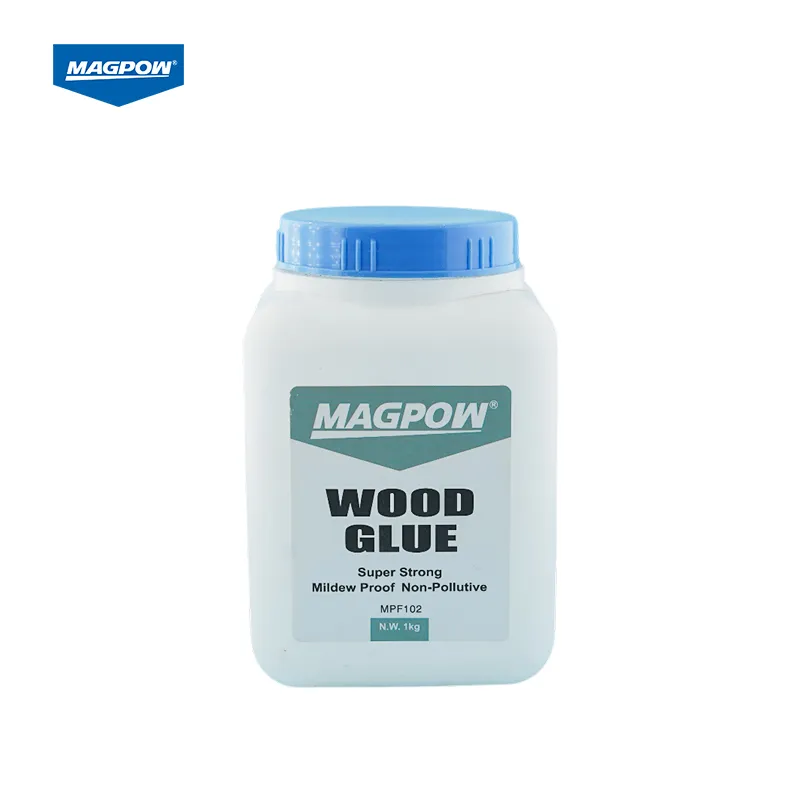
Valid Applications & Critical Scenarios Where White Wood Glue Should Be Avoided
White wood glue is purpose-built for indoor dry-service environments. Typical qualified uses cover furniture-frame joinery, cabinet construction, wooden case / crate assembly, picture-frame fabrication, wood-based handicrafts, educational wood kits and paper-tube lamination. It also finds extensive adoption within packaging and printing sectors for cardboard and paper-board bonding.
Nevertheless, white PVA is not an all-purpose adhesive. Standard D2-type white wood glue must not be used for outdoor exposure, continuously damp interior zones, highly-loaded joints requiring water resistance, or assemblies subject to repeated sharp temperature swings. For these demanding service conditions, upgrade options include D3 / D4 moisture-resistant PVA grades, polyurethane wood glue or two-part epoxy systems.
For customers requiring improved humidity resistance for semi-exposed indoor projects, MAGPOW supplies D3-modified PVA variants that extend real-world service life under intermittent moisture, removing the need to fully switch over to epoxy or PU adhesives for certain cabinet linesmagpow.net.
Practical Buying & Bulk-Sourcing Checklist for White Wood Glue
When evaluating white wood glue for purchase, start from your actual working environment and manufacturing processes.
1. Confirm end-use environment: confirm whether finished products serve strictly indoor dry conditions or face periodic moisture exposure, and select corresponding D2 / D3 grade accordingly.
2. Match viscosity to application hardware: automatic gluing stations generally need free-flowing low-viscosity adhesive; hand-assembly workshops prefer thicker, anti-run products.
3. Verify compliance documentation: for exports toward EU or North-American markets, confirm availability of MSDS, COA, REACH and other mandatory certification files.
4. Mandatory pre-bulk-order sample validation: run practical trial tests using your actual local timber substrates, evaluating open assembly window, cure rate, foaming tendency and final glue-line visual quality before committing to large orders.
For factory purchasers, stable production capacity and responsive technical support weigh equally alongside unit pricing. A trusted industrial-grade supplier can deliver formulation adjustment, flexible packaging configurations, plus professional technical guidance covering recommended clamp hold time and optimal glue-spread rate.
MAGPOW operates automated production lines delivering over 50 000 tons annual adhesive capacity, with standard 7-15-day production lead-time supported by a global logistics network, catering to order sizes starting from small 5-kg trial batches through full container-load bulk shipmentsmagpow.net.
Conclusion
White PVA wood glue remains a cost-efficient, operator-friendly bonding solution for indoor woodworking and craft production. It excels for projects calling for inconspicuous glue seams, generous assembly adjustment windows and solvent-free water-based cleanup. Success hinges entirely on respecting its moisture-sensitivity limitation and avoiding misapplication in wet or outdoor operating contexts.
Whether managing a small carpentry shop or operating high-volume furniture manufacturing facilities, selecting batch-stable, properly certified white wood glue directly lowers reject rates and keeps assembly lines running efficiently. If you require technical data sheets, lab reports or free sample trials for your wood-production projects, reach out to MAGPOW’s adhesive engineering team via https://magpow.net/ to explore custom-formulation support tailored for your application.