
 EN
 ru
 pt
Why Many Woodworking Factories Prefer a Stable Wood Glue Manufacturer
Nov 11, 2026Wood glue functions as a core process consumable rather than an auxiliary supply for modern woodworking plants. Minor performance deviations between batches can trigger visible production risks: joint delamination, inconsistent bond strength, defective surface finishing and higher rework rates. Such issues erode profit margins and damage delivery reliability, which is why experienced woodworking factories weigh manufacturer stability above unit-price when screening adhesive suppliers.
Batch Consistency Determines Long-Term Production Quality
Formula consistency across bulk batches stands as the primary evaluation metric. Viscosity, solid content, open-time and curing speed must remain predictable under mass-production conditions. Even subtle parameter shifts disrupt glue spreading on automated lines and produce uneven bonding outcomes. Trustworthy manufacturers enforce full-chain raw-material inspection and finished-product sampling for every shipment. With decades-long adhesive R&D and manufacturing background, MAGPOW implements batch-by-batch lab testing to stabilize formulation performance for large-volume industrial clients. Its manufacturing system supports both heavy-duty industrial wood glue for furniture workshops and niche craft-oriented adhesive lines for downstream buyers.
Reliable Supply Chains Avoid Costly Production Stops
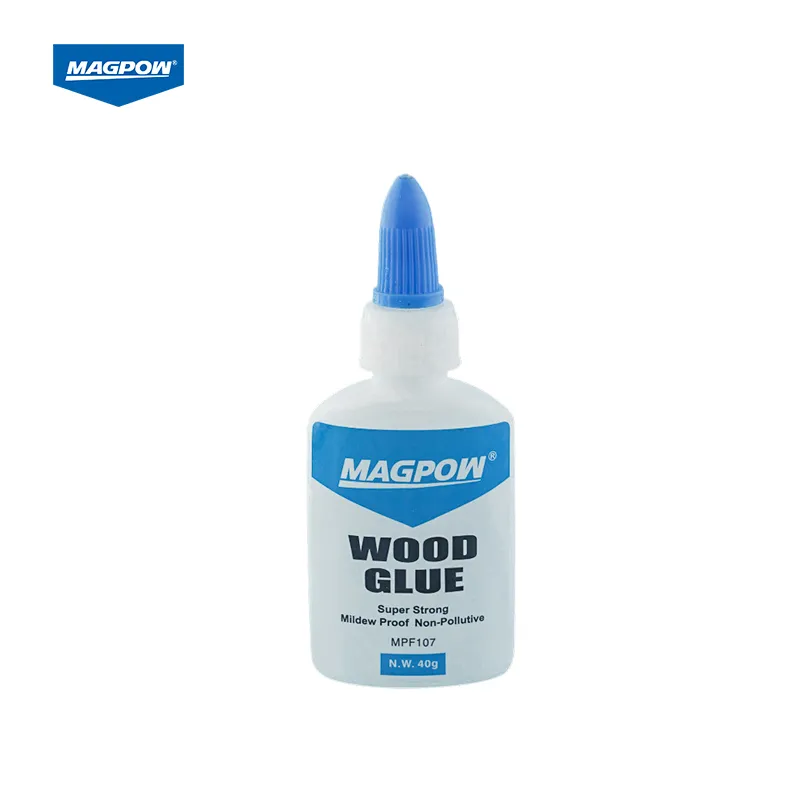
Dependable supply capacity and transparent lead-time management form another critical selection criterion. Woodworking sectors face seasonal order surges; unexpected adhesive shortages may halt whole production lines and delay client shipments. Factories tend to partner with integrated manufacturers equipped with automated production workshops, sufficient raw-material reserves and mature cross-border logistics frameworks. As shown on its official site https://magpow.net/, MAGPOW supports flexible MOQ for trial batches as well as full-container mass orders, maintaining a stable 7-15-day production cycle to help overseas buyers mitigate stock-out risks. Beyond industrial-grade bulk adhesives, the supplier also serves stationery wholesalers and DIY craft producers with retail-oriented items such as MPF107 40g mini PVA wood glue ), designed for fine craft-model assembly and retail shelf distribution.
Technical Support and Compliance for Export Wood Products
Technical support and regulatory compliance should never be overlooked. Actual bonding results vary greatly depending on wood species, timber moisture content, pressing temperature and ambient workshop humidity. A qualified supplier needs to provide technical datasheets, SDS documents, application guidance and sample-testing support instead of only selling finished goods. For export-oriented wood products, the binding requirement is formaldehyde emission, not VOC: EN 717-1 E1 for the EU, CARB ATCM Phase 2 / TSCA Title VI for the US, GB 18583 domestically. A batch that fails E1 does not get detained at customs — it gets rejected by your customer after the finished panel is tested, which is far more expensive.
Practical Framework to Assess a Wood Glue Supplier
Below are practical suggestions for procurement and technical teams.
Avoid judging wood glue suppliers purely on quoted unit prices. Calculate total ownership costs including reject losses, rework labor, production-downtime risks and after-sales value. Run small-scale production trials using candidate adhesives before locking long-term contracts, to verify real-world performance under your on-site working conditions.
Reliable wood glue manufacturers share common markers: strict internal quality-control workflows, scalable manufacturing capacity, complete compliance documentation and accessible technical consultation. Building cooperation with such suppliers helps woodworking factories lower hidden operational risks and sustain steady product quality over long-term production cycles.
FAQ
What is the most critical test indicator for industrial wood glue for export furniture?
Formaldehyde emission remains the core indicator. Products shipped to Europe need to meet EN 717-1 E1, while shipments to the United States must comply with CARB ATCM Phase 2 and TSCA Title VI.
Why is batch consistency more important than a lower purchase price for wood glue?
Small fluctuations in viscosity or curing speed will create scattered defective workpieces on automated gluing lines. The cumulative cost of rework, scrapped timber and delayed orders usually far outweighs any savings from cheaper glue.
Can one adhesive manufacturer supply both industrial bulk glue and small retail craft glue?
Yes. Scalable manufacturers such as MAGPOW maintain separate production lines and quality protocols for industrial bulk orders and packaged retail SKUs, keeping independent formulation controls for each application.